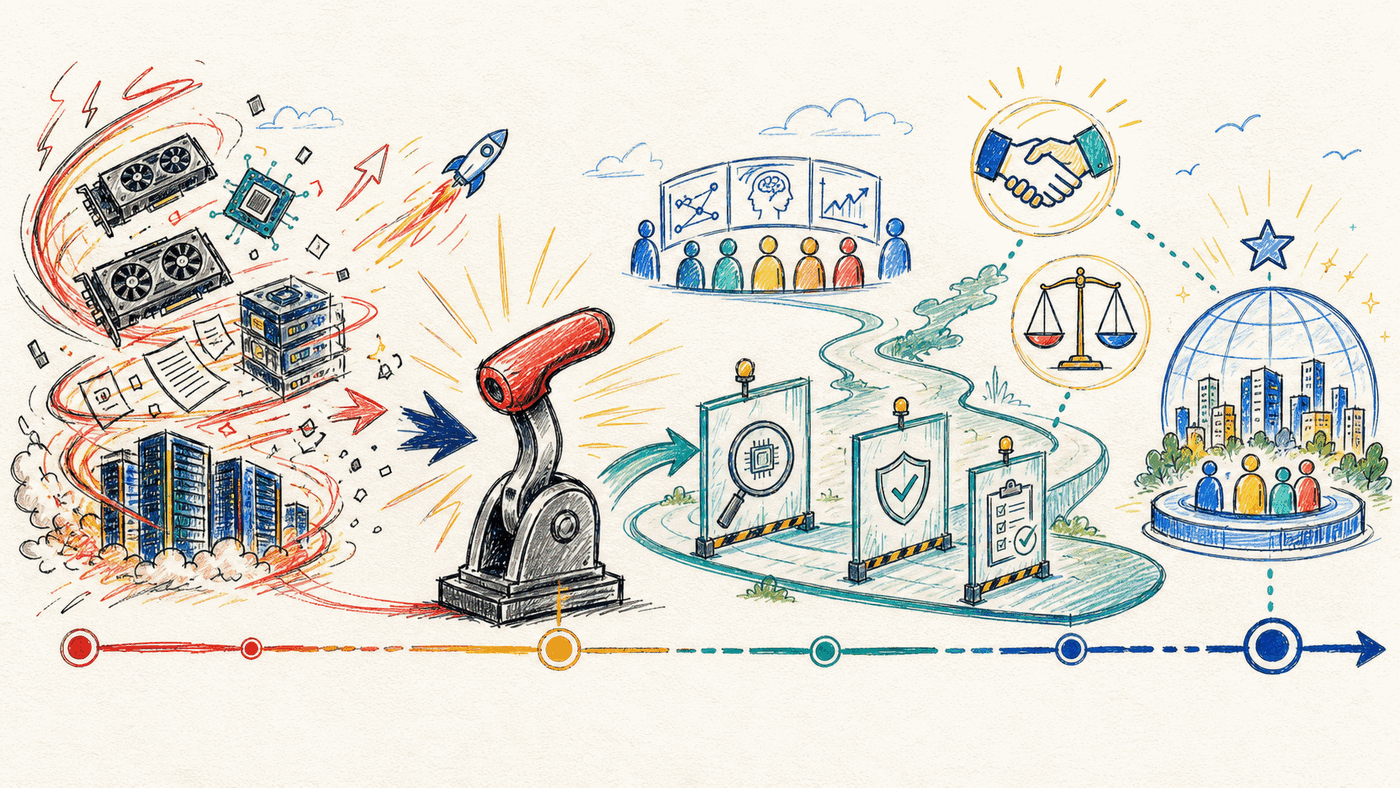
Discussions about artificial intelligence often treat speed as a force of nature. Models become more capable, companies buy more infrastructure, and governments try to keep up. In that framing, slowing down sounds like a purely moral choice: one side asks for caution, while the other replies that competition makes caution impossible.
Yet a serious slowdown is not a pause for reflection. It is an institutional engineering problem. It must specify what will be measured, who may verify it, which limits apply, and how to keep the most cautious participant from being punished for following the rules. Without those details, “go slower” remains a wish. With them, it becomes an architecture that can be tested and challenged.
Speed is not the same as value
Demand for AI can remain strong while buyers become more demanding about returns. This shift matters because technical capability and economic value do not necessarily move at the same pace. More chips, parameters, and energy do not guarantee that a system will solve relevant tasks reliably enough to justify its cost.
The same applies to autonomy. An agent completing a long task in half its attempts is an interesting research result, but it is still a coin toss in a real operation. In physical environments, the gap between a persuasive demonstration and a dependable process appears in unglamorous details: repetition, data, storage, validation, and failure handling.
Replacing a fixation on speed with a discipline of value does not mean abandoning innovation. It means asking which additional capability creates a verifiable benefit and which merely increases exposure to costs and risks we do not yet know how to manage.
A brake needs sensors
Limits that cannot be observed are easy to ignore. Any credible slowdown therefore depends on measurable points: large concentrations of computing capacity, training runs, safety evaluations, energy use, and meaningful changes in system autonomy.
This observation layer must also avoid two extremes. Vague transparency provides too little evidence; unrestricted surveillance creates new risks and concentrates power in whoever controls inspection. A stronger design combines a defined scope, auditable records, independent verifiers, and explicit rules for access, appeals, and remediation.
In other words, the brake is not merely a ban. It is a control loop: measure the system, compare its state with agreed limits, and trigger proportionate responses when it deviates.
Coordination without blind trust
Competition among companies and countries makes unilateral promises fragile. A participant that slows down may fear that a rival will use the pause to pull ahead. The answer cannot depend on personal trust; it must reduce the advantage of cheating and increase the likelihood of detection.
That requires verifiable agreements, shared criteria, and predictable consequences. It also requires admitting that aggressive deterrence can create instability of its own. A rule designed to prevent secret races may increase tension if it leaves doubt about who decides that a violation occurred or which responses are legitimate.
The central choice is not between trust and force. It is whether institutions can make cooperation rational even when participants disagree, compete, and remain suspicious of one another.
Purchased time needs a purpose
Slowing down only matters if the extra time is used. A pause should fund better evaluation methods, auditing infrastructure, control research, preparation for labor-market changes, and mechanisms that distribute benefits. Otherwise, risk is postponed without improving our ability to confront it.
Criteria for moving forward matter just as much. What evidence would justify lifting a limit? Which failures would require strengthening it? Who represents the groups affected by these decisions? Without answers, a moratorium can become permanent paralysis or end under political pressure before safeguards are ready.
Conclusion
The most useful debate is not “accelerate or stop.” It is which capabilities may advance, under what evidence, and with what responsibilities. Caution stops being abstract when it gains metrics, verifiers, records, and remediation mechanisms.
Coordinating economic and geopolitical interests around ambitious limits may be unlikely. Still, turning a slowdown into a concrete design already improves the discussion: it exposes weak assumptions, allows failure scenarios to be simulated, and makes alternatives comparable. Before asking how quickly AI can advance, we need to answer a harder question: what infrastructure of trust must exist for that progress to be socially defensible?